Budget 2026: Will the Middle-Class Upgrade Close the Gap Between Income and Inflation?
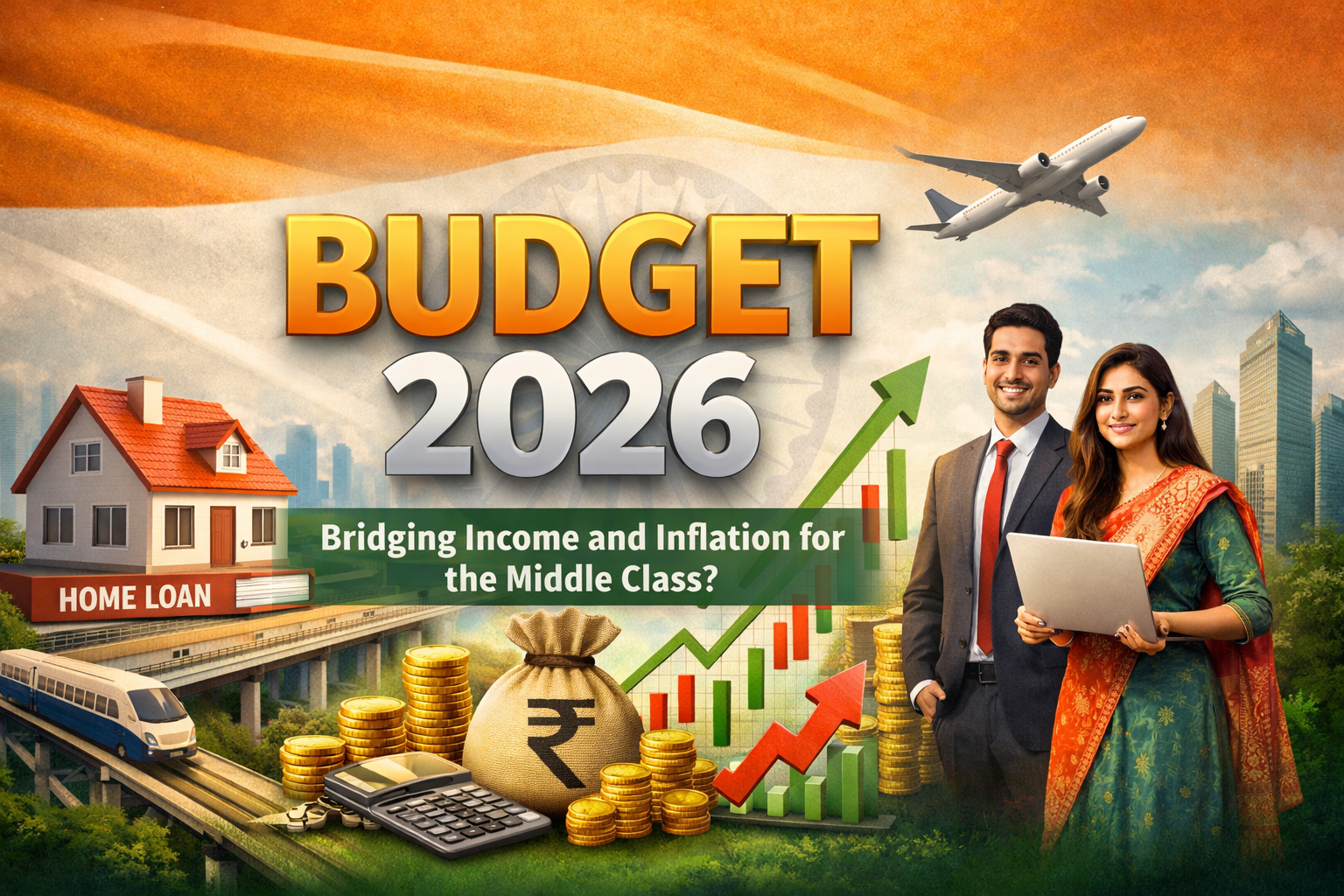
Budget 2026: Will the "Middle-Class" Upgrade Close the Gap Between Income and Inflation?
As the 2026 Union Budget approaches, the Indian middle class is looking for the next level of fiscal empowerment. The 2025 Budget marked a meaningful shift in policy direction: the government rationalised GST slabs and established a practical tax-free threshold of ₹12 lakh under the New Tax Regime, providing relief to a broad base of taxpayers.
Yet for many mid-income professionals — particularly those earning between ₹15 lakh and ₹35 lakh — rising urban living costs have diluted the impact of recent income gains. As expectations build ahead of Budget 2026, here is what many hope the government will deliver to ensure rising incomes translate into lasting financial confidence and opportunity.
1. The “30% Cliff”: A Proposal to Strengthen Disposable Income
One of the most widely discussed expectations is further rationalisation of tax slabs. In 2025, the threshold for the 30% tax rate was moved to ₹24 lakh. With the 8th Pay Commission expected to be implemented from January 2026, upward revisions in government pay could also influence private sector salary benchmarks.
The Expectation:
There is growing market consensus around moving the 30% threshold closer to ₹30 lakh. Such a step could help professionals retain a greater share of incremental income, supporting consumption while providing a cushion against persistent urban inflation.
2. A Key Gap: Bringing Housing Incentives to the New Regime
A structural challenge remains within the New Tax Regime: limited incentives for homeownership. Currently, the deduction for home loan interest under Section 24(b) is largely unavailable for self-occupied properties under the new structure, prompting many taxpayers to remain in the old regime.
The Market View:
To truly establish the New Tax Regime as the default choice, industry experts have suggested the introduction of a targeted housing deduction — potentially up to ₹3 lakh — within the new framework, especially for first-time buyers. Broadening the definition of “affordable housing” to include properties up to ₹75 lakh in Tier-1 cities could also provide momentum to a segment that has seen muted growth in recent quarters.
3. Standard Deduction: Pushing Toward ₹1 Lakh
The 2025 Budget increased the standard deduction for salaried individuals to ₹75,000. There is now a consistent proposal from tax professionals to raise this to a rounded ₹1,00,000 in 2026.
The Impact:
Under the New Tax Regime, this could make income up to roughly ₹13 lakh effectively tax-free for salaried individuals when combined with the Section 87A rebate.
The Logic:
Beyond tax relief, such a measure would further simplify compliance and provide immediate liquidity for younger professionals entering the workforce.
4. GST 2.0: Beyond Simplification
The GST overhaul of the previous year significantly rationalised the tax structure, reducing complexity and lowering rates across several categories of goods and services, while retaining a 40% demerit rate for luxury and sin goods.
The Outlook:
For 2026, middle-class expectations extend to finer “micro-rationalisation.” In particular, there is growing sentiment that health and life insurance premiums should be taxed at lower rates, given their role as essential social protection rather than discretionary consumption.
5. Capital Gains: The Quest for Consistency
There is ongoing market discussion around the possibility of a Unified Capital Gains Framework. While no official proposal has been confirmed, policy analysts have explored the idea of standardising holding periods — for instance, 12 months for listed assets and 24 months for unlisted assets — alongside a simplified flat rate of around 12.5%.
Such a reform, if pursued, could significantly reduce complexity for retail investors and strengthen long-term participation in financial markets.
Editorial Perspective
Budget 2026 is widely expected to be a phase of fine-tuning rather than structural reinvention. Much of the groundwork was laid in 2025. The opportunity now lies in ensuring that incremental income gains — including those expected from the 8th Pay Commission — are channelled into productive avenues such as housing, financial assets, and long-term savings.
If the budget succeeds in refining incentives without compromising fiscal discipline, it could mark a meaningful step toward a more confident, financially secure middle class.
Published by Fibstory Editor